What Is Off Page SEO? Strategies, Techniques & Complete Checklist 2026

You’ve created amazing content, but your competitors still rank higher in Google search results. What’s missing?
The answer is off-page SEO. While you control everything on your website, off-page SEO happens outside your site. It includes all the actions taken beyond your website to improve search rankings—often supported through professional off-page SEO services that focus on backlinks, brand mentions, and authority building.
This guide explains what is off-page SEO is and why it matters. You’ll learn proven techniques, effective strategies for 2026, and get a complete checklist to follow.
Understanding Off-Page SEO: What It Actually Means
Off-page SEO is everything you do outside your website to improve where it ranks in search engines. Think of your website as a person applying for a job. On-page SEO is your resume; it shows what you can do and lists your qualifications.
While on-page SEO focuses on your content quality, title tags, meta descriptions, and site structure, things you completely control, off-page SEO deals with factors outside your direct control. You cannot force other websites to link to you.
According to Moz, off-page SEO signals help search engines understand how the rest of the internet perceives your website. Are you trustworthy? Are you an authority in your field? These questions get answered through off-page factors.
1. The Core Elements of Off-Page SEO
Off-page SEO includes several key activities:
- Link building: getting other websites to link to your pages
- Brand mentions: having your brand name mentioned across the web, even without links
- Social media activity: sharing content and building engagement on social platforms
- Influencer marketing: working with influential people to promote your brand
Why Off-Page SEO Matters So Much for Rankings?
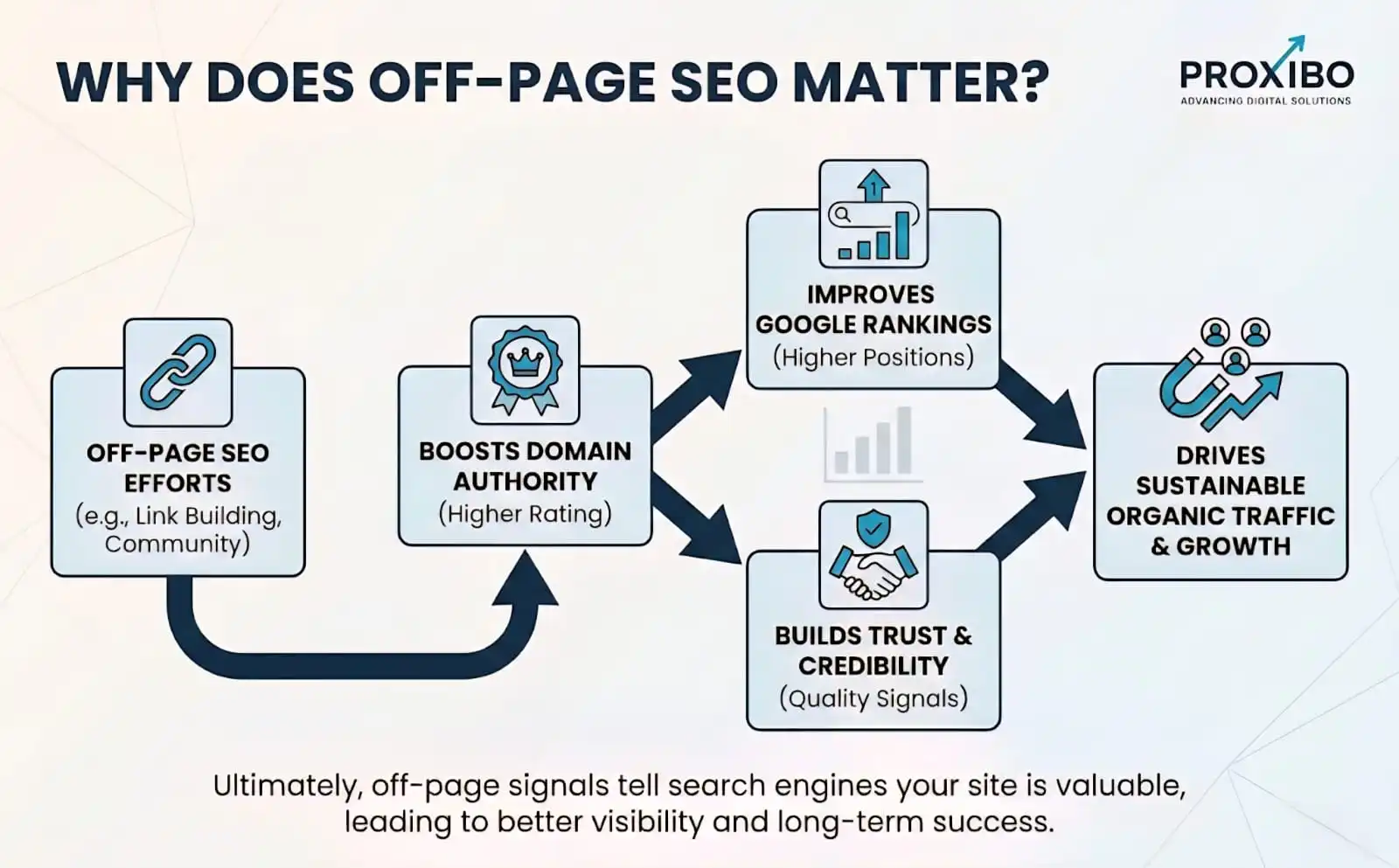
Google uses over 200 ranking factors to decide which pages appear where in search results. Many of these factors relate directly to off-page SEO. In fact, Google has publicly confirmed that backlinks remain one of their top three ranking signals, alongside content quality and RankBrain (their machine learning system).
The relationship between backlinks and rankings is clear and proven. Multiple studies analyzing millions of search results show a strong connection: pages with more quality backlinks consistently rank higher.
But off-page SEO goes beyond just rankings. It builds real trust and authority for your brand. When respected industry websites link to your content, their audience discovers you. When influencers mention your brand, their followers check you out.
Difference Between On-Page SEO and Off-Page SEO
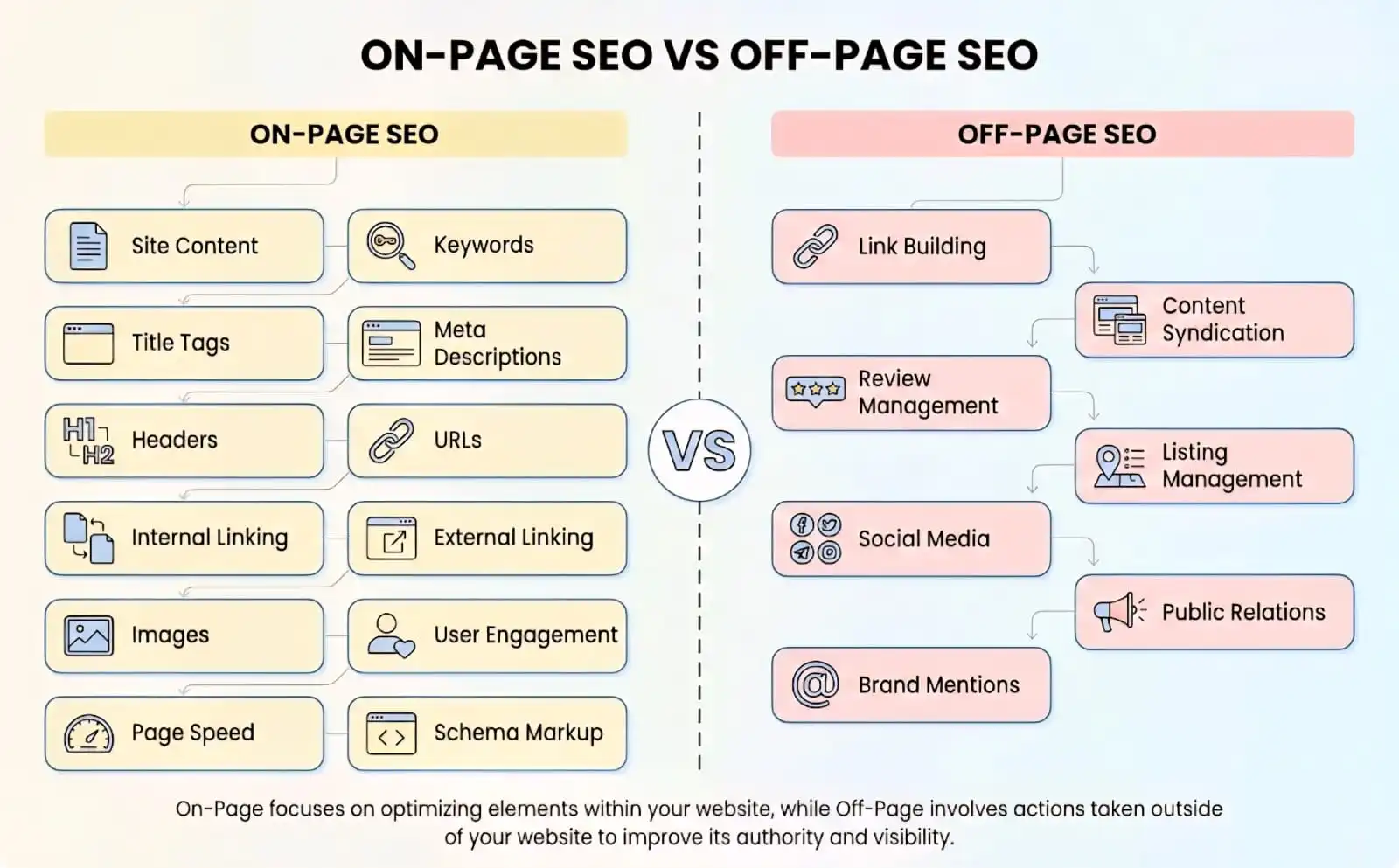
Understanding the difference between on-page and off-page SEO helps you build a complete strategy that covers both areas. Each serves distinct purposes, though they work together to improve your rankings.
On-Page SEO:
On-page SEO covers everything within your direct control on your website. This includes the quality and optimization of your content, how well you use keywords, and your title tags and meta descriptions.
It also shows your URL structure, internal linking between pages, site speed and performance, mobile-friendliness, image optimization, and your overall site architecture. You have complete control over these elements and can change them whenever you want.
Off-Page SEO:
Off-page SEO happens beyond your website on platforms and sites you do not control. The main components are backlinks from other websites, social media signals and engagement, brand mentions across the web, online reviews and ratings, influencer endorsements, guest posts on other blogs, and your overall online reputation.
You cannot directly control these factors; you can only influence them through outreach, relationship building, and creating content worth talking about.
The Most Powerful Off-Page SEO Techniques
1. Link Building Done Right
Quality matters far more than quantity:
- A link from a respected industry website beats 100 links from random blogs
- Links from sites in your niche carry more weight than unrelated sites
- Editorial links (earned naturally) are stronger than self-created links
- Links placed within actual content work better than footer or sidebar links
2. Guest Blogging for Authority and Links
Writing articles for other websites in your industry serves multiple purposes. You get a backlink (usually in your author bio or within the content), you expose your brand to new audiences, and you build your reputation as an expert. The key is choosing the right sites to write for and creating genuinely valuable content.
3. Social Media Engagement That Drives Results
Social signals do not directly impact rankings the way backlinks do. Google has stated this clearly. However, social media supports your off-page SEO efforts in important ways.
When you share content on social media, you increase its visibility. More people see it, which means more people might link to it. Social media helps you build relationships with influencers, journalists, and other website owners.
Brand Mentions and Citations
Monitor your brand mentions using tools like Google Alerts or specialized monitoring services. When you find mentions without links, reach out politely and ask if they would add a link. Many publishers will comply since you are just asking them to link to the brand they already mentioned.
4. Influencer Outreach and Partnerships
Influencers have built audiences that trust their recommendations. When an influencer mentions your brand, shares your content, or links to your website, you get exposure to their followers. This can lead to direct traffic, new backlinks as their followers discover you, and increased brand awareness.
5. Publishing Content on External Platforms
Platforms like Medium, LinkedIn articles, and industry-specific blogs let you publish content that reaches new audiences. These platforms have high authority, so content published there often ranks well. Include links back to your website where relevant.
Question-and-answer sites like Quora and Reddit offer chances to establish expertise. Answer questions in your field with genuinely helpful responses. Link to your detailed content when it directly answers the question. This positions you as an expert while building backlinks naturally.
Off-Page SEO Strategies That Will Work in 2026
1. Digital PR: The Modern Link Building Approach
Digital PR combines traditional public relations tactics with SEO goals. Instead of just trying to get links, you aim to get featured in online publications, podcasts, news sites, and industry blogs. These features naturally include backlinks while also building brand awareness and credibility.
Journalists constantly need expert sources and interesting stories. Position yourself as an expert by responding to journalist requests on platforms like Help A Reporter Out (HARO), Featured, and SourceBottle.
2. Create Content People Naturally Want to Link To
The best link building happens when you do not have to ask for links. Create assets that naturally attract links because they provide unique value. This strategy works long-term because these assets continue earning links months or years after you publish them.
Types of content that attract links naturally:
- Original research and data studies : people love citing unique statistics
- Comprehensive guides that become go-to resources in your field
- Free tools and calculators that solve specific problems
Research from Backlinko shows that long-form content (over 3,000 words) gets 77.2% more backlinks than shorter articles. Depth matters. Create resources so thorough that they become the obvious choice when people need to link to information about your topic.
3. Build Real Relationships, Not Just Links
The most sustainable off-page SEO strategy is building genuine relationships with other people in your industry. Website owners, bloggers, journalists, influencers, these relationships lead to natural link opportunities that paid tactics cannot match.
Start by being helpful without expecting anything back. Comment thoughtfully on other blogs. Share their content on social media when it is genuinely good. Offer insights or help when people ask questions in your field. Build a reputation as someone who adds value to the community.
4. Video Content and YouTube SEO
Video content on YouTube and other platforms creates multiple off-page SEO benefits. Videos often rank in Google search results alongside text pages, giving you extra visibility. YouTube itself is the second-largest search engine, so ranking there brings significant traffic.
Include links to your website in video descriptions. Create videos that answer common questions in your industry. When people search those questions, your video might appear, driving traffic back to your site.
5. Reviews and Reputation Management
Online reviews on platforms like Google Business Profile, Yelp, Trustpilot, and industry-specific review sites contribute to your off-page SEO. Positive reviews build trust signals that search engines recognize.
Actively encourage satisfied customers to leave reviews. Make it easy by sending follow-up emails with direct links to your review profiles. Respond to all reviews, both positive and negative, professionally.
What Off-Page SEO Tactics Should You Avoid?
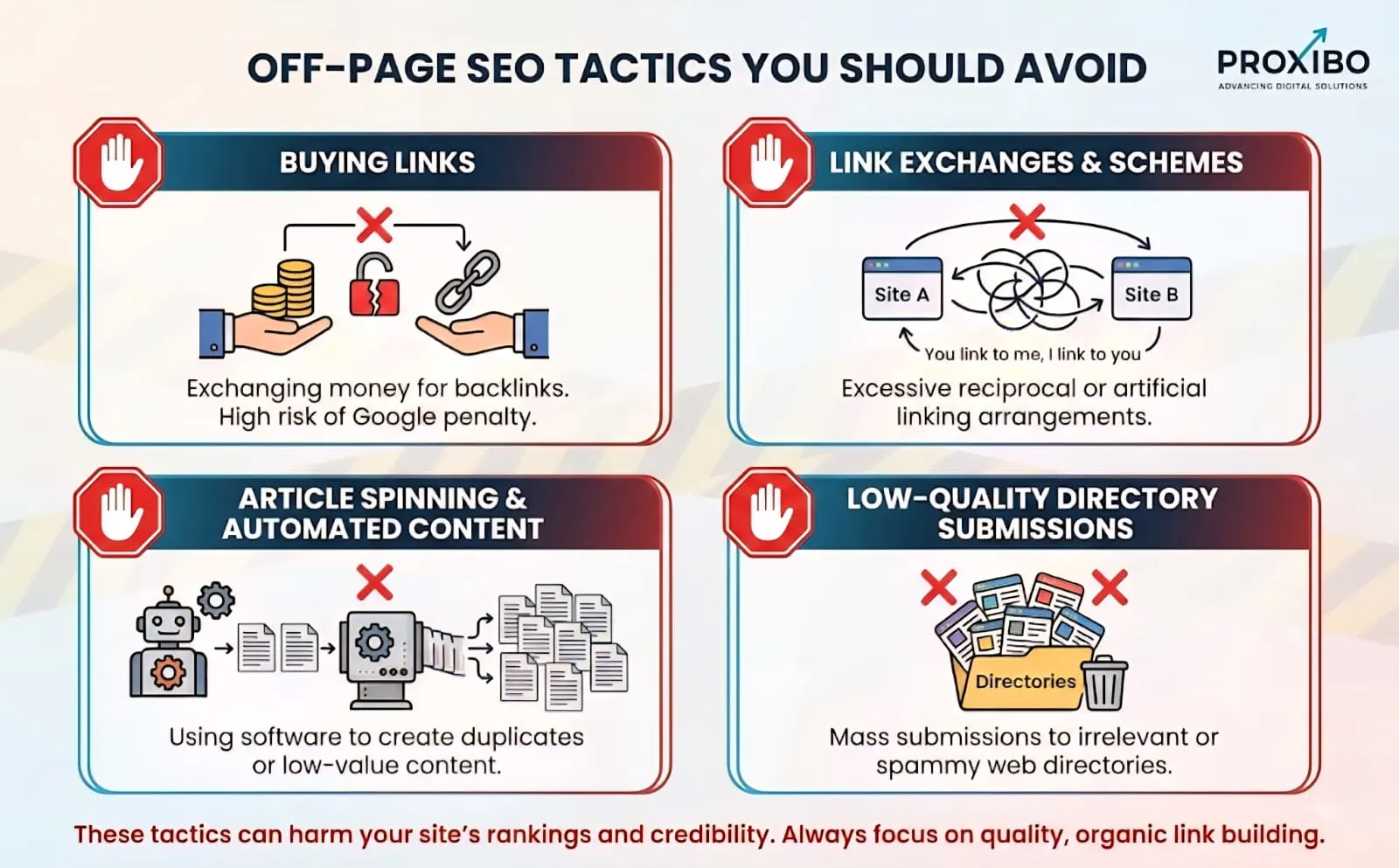
1. Buying Links:
2. Link Exchanges and Link Schemes:
Trading links with other sites just to manipulate rankings does not work anymore. Google can spot these patterns. Occasional reciprocal links with partners are fine, but systematic link trading is risky.
3. Low-Quality Directory Submissions:
Submitting your site to hundreds of random directories provides zero value. Focus on legitimate, industry-specific directories and local business directories like Google Business Profile. Quality over quantity always wins.
4. Article Spinning and Automated Content:
Creating slightly different versions of the same article to post across multiple sites is obvious to both readers and search engines. Write original content for each platform or skip it entirely.
Building Your Off-Page SEO Foundation
Off-page SEO is the crucial work done outside your website to build authority, trust, and visibility in search engines. From link building to social media engagement, these techniques work together to improve rankings. Use the strategies and checklist in this guide to create a comprehensive off-page SEO plan for 2026—and if you need expert support from a trusted digital marketing agency, contact Proxibo to get started.
The ideal title tag length is 50–60 characters. Use the title tag examples from this guide to create effective titles for different page types. Start with the most important pages and systematically optimize the rest of your site—and if you need expert help, contact Proxibo for professional SEO support.
Frequently Asked Question
Yes, but your results will be limited. Link building is the most powerful off-page SEO technique.
There's no fixed number. Quality matters more than quantity.
Social media doesn't directly impact rankings, but it supports off-page SEO in several ways.
Off-page SEO includes a wide range of activities beyond your website, like first link building through guest posting. Then Social media marketing and engagement on platforms your audience uses. Lastly, Brand mention building and monitoring for unlinked mentions
On-page SEO is your foundation. Without solid on-page optimization, even the best backlinks will not push you to the top. Off-page SEO is what takes you from good to great. It builds the authority and trust signals that separate top-ranking pages from those stuck on page two or three.
Use backlink analysis tools like Ahrefs, SEMrush, or Moz to see your complete backlink profile, including new links, lost links, and link quality metrics.
ABOUT THE AUTHOR

Related Posts