How to Do E-commerce On-Page SEO: Complete Implementation Guide

Your e-commerce store has thousands of products, but search engines struggle to understand what you sell. Potential customers search for exactly what you offer, yet they find your competitors instead of you.
This guide shows you exactly how to do e-commerce on-page SEO step by step.
What Is E-commerce On-Page SEO?
How to do e-commerce On-Page SEO starts with understanding what it means. On-page SEO for e-commerce includes all optimization you do directly on your website pages to improve rankings and conversions. This differs from off-page SEO, which happens outside your site through backlinks and social signals.
For e-commerce stores, on-page SEO focuses on product pages, category pages, and how information is structured, highlighting the benefit of technical SEO for ecommerce. You optimize titles, descriptions, images, URLs, and internal links. Each element signals to search engines what your pages contain and why they deserve strong rankings.
Why Is On-Page SEO Critical for E-commerce Success?
- Search engines need clear signals. Customers make quick decisions: People scan search results in seconds. Your optimized titles and descriptions convince them to click your link instead of competitors.
- Product page SEO drives conversions: Well-optimized pages load fast, display correctly on mobile, and provide complete information. These factors increase conversion rates significantly.
- On-page optimization compounds over time:
What Are the Essential Elements of E-commerce On-Page SEO?
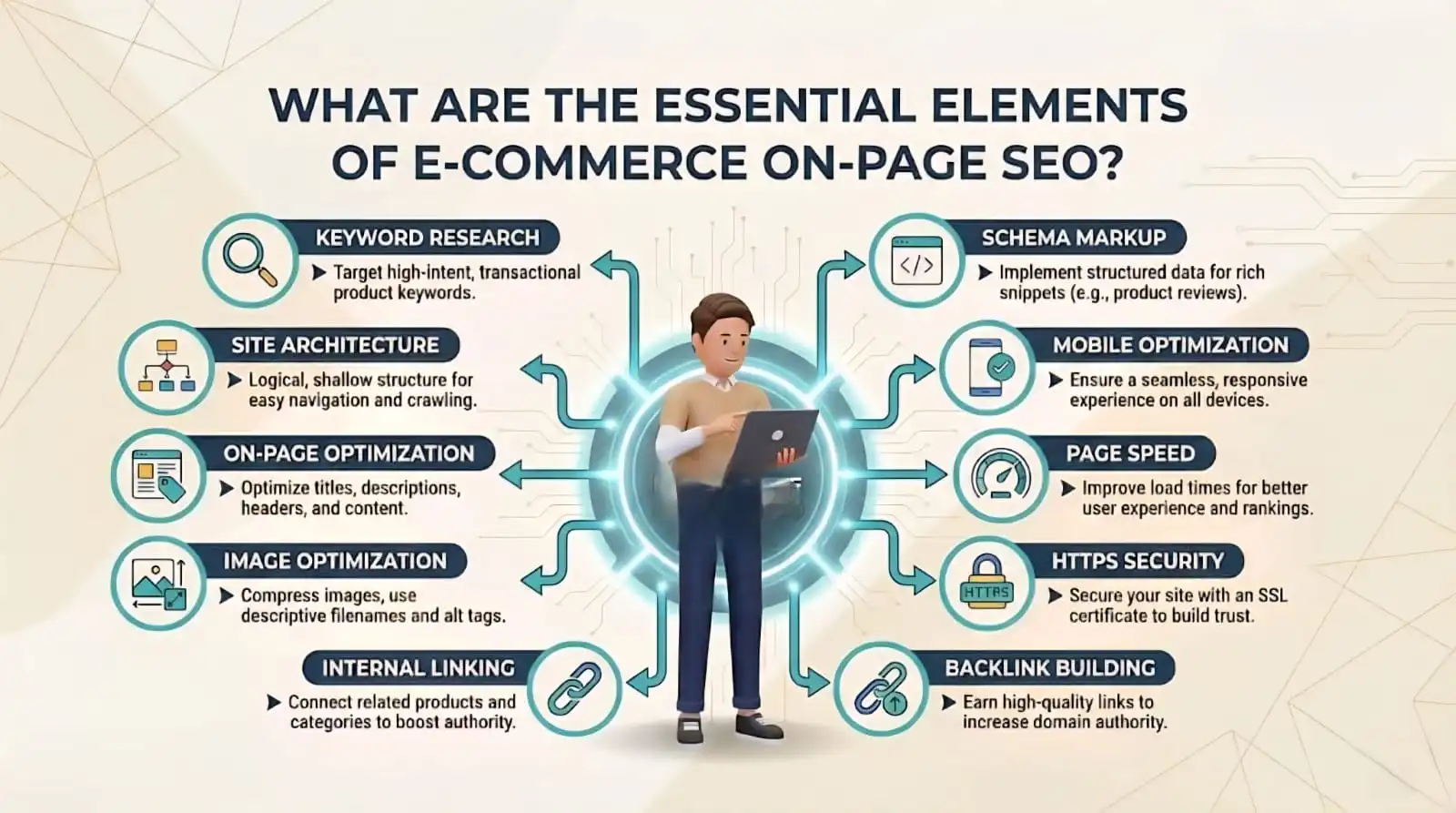
- Title tags appear in search results: This clickable headline determines whether people visit your page. Include your main keyword and product name. Keep titles under 60 characters so they display fully in search results.
- Meta descriptions summarize your page: These text snippets appear below titles in search results. Write compelling descriptions that include keywords and benefits. Use 150-160 characters to avoid truncation.
- Header tags structure your content: Use H1 for product names, H2 for main sections, and H3 for subsections. Headers help both readers and search engines understand your content hierarchy.
- URL structure affects usability and SEO: Create short, descriptive URLs that include keywords. Use hyphens to separate words. Avoid long URLs with unnecessary parameters or numbers.
- Product descriptions provide essential information: Write unique descriptions for each product. Include specifications, benefits, and usage information. Avoid copying manufacturer descriptions that create duplicate content.
- Images require proper optimization: Compress images to reduce file size without losing quality. Use descriptive file names with keywords. Add alt text that describes images for accessibility and SEO.
- Internal links connect related pages: Link from product pages to related products, categories, and helpful content. These connections help search engines discover all your pages and understand relationships between them.
- Schema markup provides structured data: Add product schema to tell search engines about prices, availability, and reviews.
What Are URL Structure Best Practices for E-commerce?
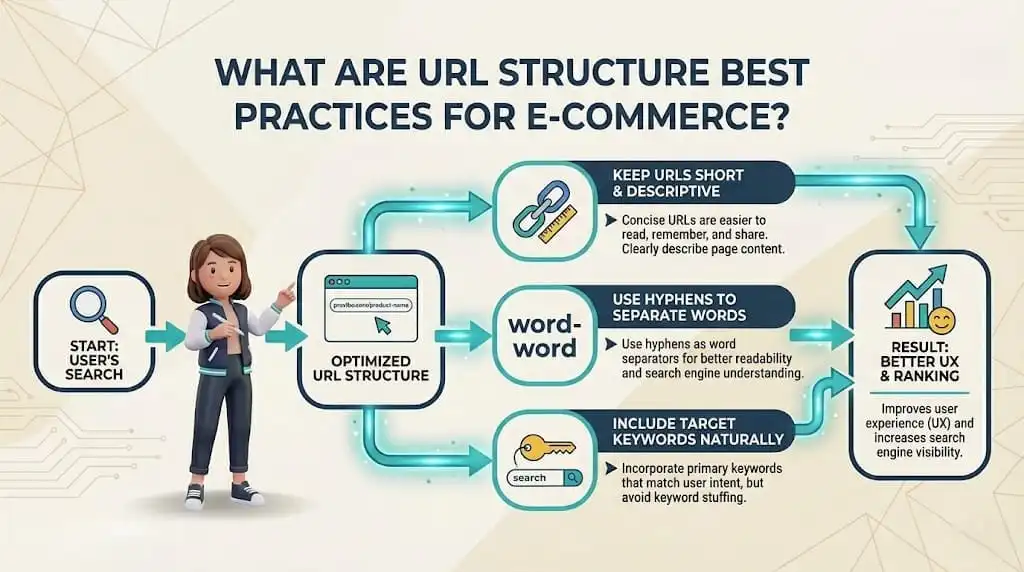
- Keep URLs short and descriptive: Include only essential information. A good URL might look like: yourstore.com/mens-running-shoes/nike-air-zoom.
- Use hyphens to separate words: Hyphens are easier to read than underscores or no separators. Search engines treat hyphens as spaces. This makes your URLs more readable in search results and when shared.
- Include target keywords naturally: Add your main keyword in the URL when it makes sense. Don’t force keywords or make URLs awkwardly long.
How Do You Optimize Product Pages for SEO?
Ecommerce product page optimization requires attention to multiple elements working together. Follow this systematic approach for each product page.
- Start with keyword research. Identify keywords customers use to find products like yours. Include product names, brand names, features, and use cases. Tools like Google Keyword Planner help discover relevant search terms with good volume.
- Optimize your product title tag. Include the main keyword, product name, and brand. Format might be: “Product Name – Key Feature | Brand Name.” Keep it concise and compelling.
- Write unique product descriptions. Create original content for every product. Describe features, benefits, specifications, and ideal uses. Aim for 300-500 words for main products.
- Add high-quality images. Use multiple images showing different angles and uses. Compress images to maintain quality while reducing file size.
Conclusion
Learning how to do e-commerce on-page SEO transforms how search engines understand and rank your store. As part of professional digital marketing services, on-page SEO helps you create clear, helpful product pages optimized for both search engines and customers, improving visibility, traffic, and conversions.
The ideal title tag length is 50–60 characters. Use the title tag examples from this guide to create effective titles for different page types. Start with the most important pages and systematically work through the rest of the site—and if you need expert help, contact Proxibo to get started.
Frequently Asked Question
Each product page should have 5-10 relevant internal links. Include links to the parent category, related products, and helpful content. Too many links dilute their value and overwhelm customers.
No, use a responsive design that adapts to different screen sizes. Google uses mobile-first indexing, so your mobile version determines rankings.
Write unique descriptions of 300-500 words that include relevant keywords naturally. Focus on benefits, then list features and specifications. Answer common customer questions within descriptions.
ABOUT THE AUTHOR

Related Posts